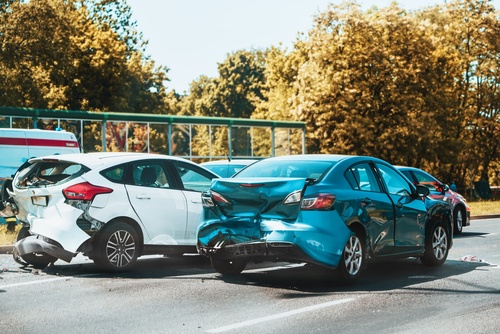
California follows a pure comparative fault rule, meaning your damages can be reduced by the percentage of responsibility assigned to you, but you’re not automatically barred from recovering compensation just because you share some fault for the crash. Even if an insurance adjuster tries to pin significant blame on you, your claim likely still has real value, and understanding how the math actually works can help you avoid accepting less than you’re owed.
At Trevino Law Firm, our personal injury attorneys help Palmdale and Antelope Valley drivers push back when insurance companies try to inflate their share of fault after a crash. If you’re being blamed in part for your accident, call (661) 526-5012 to talk with our team.
Comparative Fault Separates Total Damages From Each Party’s Percentage of Responsibility
Comparative fault involves two separate questions: what your total damages are worth, and what percentage of responsibility for the crash belongs to you versus the other party or parties involved. These are calculated independently, then combined, with your fault percentage reducing your final compensation rather than eliminating your total damages figure altogether.
Comparative Fault Breakdown Example
Consider a hypothetical driver with $100,000 in total damages from a crash. This example is purely illustrative and isn’t a prediction of what any actual case is worth.
- At 0% fault, the driver would be entitled to the full $100,000
- At 20% fault, the driver’s compensation would be reduced to $80,000
- At 50% fault, the driver’s compensation would be reduced to $50,000
- At 80% fault, the driver’s compensation would be reduced to $20,000
Under California’s pure comparative fault rule, codified through case law and applied under CACI 405, a plaintiff can theoretically recover compensation even at 99% fault, receiving 1% of their total damages. There’s no cutoff percentage in California that eliminates your claim entirely, unlike some other states.
Fault Percentage Is Not the Same as Injury Severity
Your percentage of fault and the severity of your injuries are two completely separate questions. A driver who was 30% at fault for a crash but suffered catastrophic injuries can still have a claim worth far more than a driver who was only 10% at fault but suffered minor injuries. Don’t confuse a high fault percentage with a low claim value, or a low fault percentage with a high one; both figures need to be evaluated on their own terms.
Insurers May Argue for a Higher Share of Fault
Insurance companies frequently argue for a higher fault percentage against you than the facts actually support, using your own statements, scene evidence, traffic rules, witness accounts, and sometimes formal accident reconstruction to build their case. Every fault percentage from an insurer represents a negotiating position, not a legal determination, and it’s often worth challenging.
Multiple Drivers or Companies Can Complicate Allocation
When more than one driver, company, or other party may share responsibility for a crash, fault gets apportioned among all involved parties, including, in some cases, parties who aren’t formally part of your claim.
Whether the responsible parties are jointly and severally liable, meaning each can be held responsible for the full judgment, or only liable for their individual share, involves nuanced legal rules that require individualized review based on the type of damages and parties involved in your specific case.
Evidence That Can Shift Fault: Video, Vehicle Data, Photos, and Witnesses
Building a case to challenge an unfavorable fault allocation generally requires gathering:
- Traffic camera or nearby surveillance footage
- Dashcam footage from any involved vehicle
- Event data recorder information from the vehicles involved
- Photographs of the scene, vehicle damage, and road conditions
- Statements from witnesses who saw the crash
- The official police or CHP report
- Cell phone records, if driver distraction is suspected
Common Shared-Fault Allegations Need Fact-Specific Analysis
Insurers commonly raise allegations involving speed, an unsafe lane change, driver distraction, or a seat belt issue to argue for a higher fault percentage against an injured driver.
None of these allegations automatically establishes a fixed fault percentage on their own; each requires a fact-specific analysis of the actual evidence connected to your particular crash, rather than a blanket assumption about how much any one factor should count against you.
Comparative Fault Can Affect Negotiation and Trial Strategy
An insurer’s position on fault can significantly shape settlement negotiations, sometimes involving competing expert reconstruction opinions about how the crash actually occurred. If a case proceeds to trial, a jury is ultimately responsible for allocating fault percentages among the parties based on the evidence presented, which is a different process than an insurance adjuster’s internal evaluation during settlement talks.
Do Not Accept a Percentage Just Because an Adjuster Assigned It
An insurance adjuster’s fault determination is an internal business evaluation, not a court finding, and it’s not automatically the final word on your case.
Adjusters are trained to protect their company’s bottom line, and their proposed fault percentage often reflects that goal more than an objective read of the evidence. Before accepting any fault percentage an insurer assigns you, it’s worth having the evidence independently reviewed.
California Damages Rules Still Require Separate Review
Even after a fault percentage is resolved, your damages still require their own separate review, including a distinction between economic damages like medical bills and lost wages and non-economic damages like pain and suffering, along with any liens or reimbursement obligations that may need to be satisfied out of your settlement, and, in multi-party cases, how joint and several liability issues affect what you can ultimately collect from each responsible party.
Have Trevino Law Firm Evaluate Fault and Damages Together
Fault and damages are two separate calculations, but they both need to be right before you accept a settlement offer. Our founding attorney, Darlene Trevino, brings a unique perspective to every case, having worked as an insurance claims adjuster before turning her focus to representing injured people. That firsthand experience with how insurance companies build and negotiate fault arguments is exactly what our clients need on their side when a fault percentage is being disputed.
Our bilingual attorneys represent clients throughout Palmdale and the Antelope Valley in a wide range of personal injury matters, including car accidents, truck accidents, including tractor-trailer jackknife accidents, and uninsured motorist accidents.
Contact Trevino Law Firm at (661) 526-5012 today to have your fault percentage and damages evaluated together.
California Comparative Fault Frequently Asked Questions
Can I recover if I was partly at fault for a California car accident?
Yes. Under California’s pure comparative fault rule, sharing fault for a crash reduces your compensation by your assigned percentage rather than automatically barring your claim. Even significant shared fault doesn’t necessarily eliminate your ability to recover.
Who decides the percentage of fault?
During settlement negotiations, the parties and their insurers typically negotiate a fault percentage based on the available evidence. If the case proceeds to litigation, a judge or jury ultimately decides the fault allocation based on the evidence presented at trial.
Can an insurance company’s fault decision be challenged?
Yes. An insurer’s fault determination is an internal evaluation, not a legal finding, and it can be challenged with evidence and legal arguments supporting a different allocation. It’s often worth pushing back rather than accepting an insurer’s initial fault percentage at face value.
Does comparative fault apply when several vehicles are involved?
Yes. When multiple vehicles or parties are involved in a crash, fault gets allocated among all responsible parties, which can require case-specific analysis, particularly around joint and several liability rules that affect what you can collect from each party.